
Search Engines
Product search on the storefront and in the admin runs on the database by default. For a large catalog you can connect an Elasticsearch cluster and choose where it is used.
Go to Configure >> Search Engines. It is available on the current version of Bagisto; on Bagisto 2.4 the same choices are the Search Engine, Admin Search Mode and Storefront Search Mode settings in the Search section under Configure >> Catalog >> Products.
General
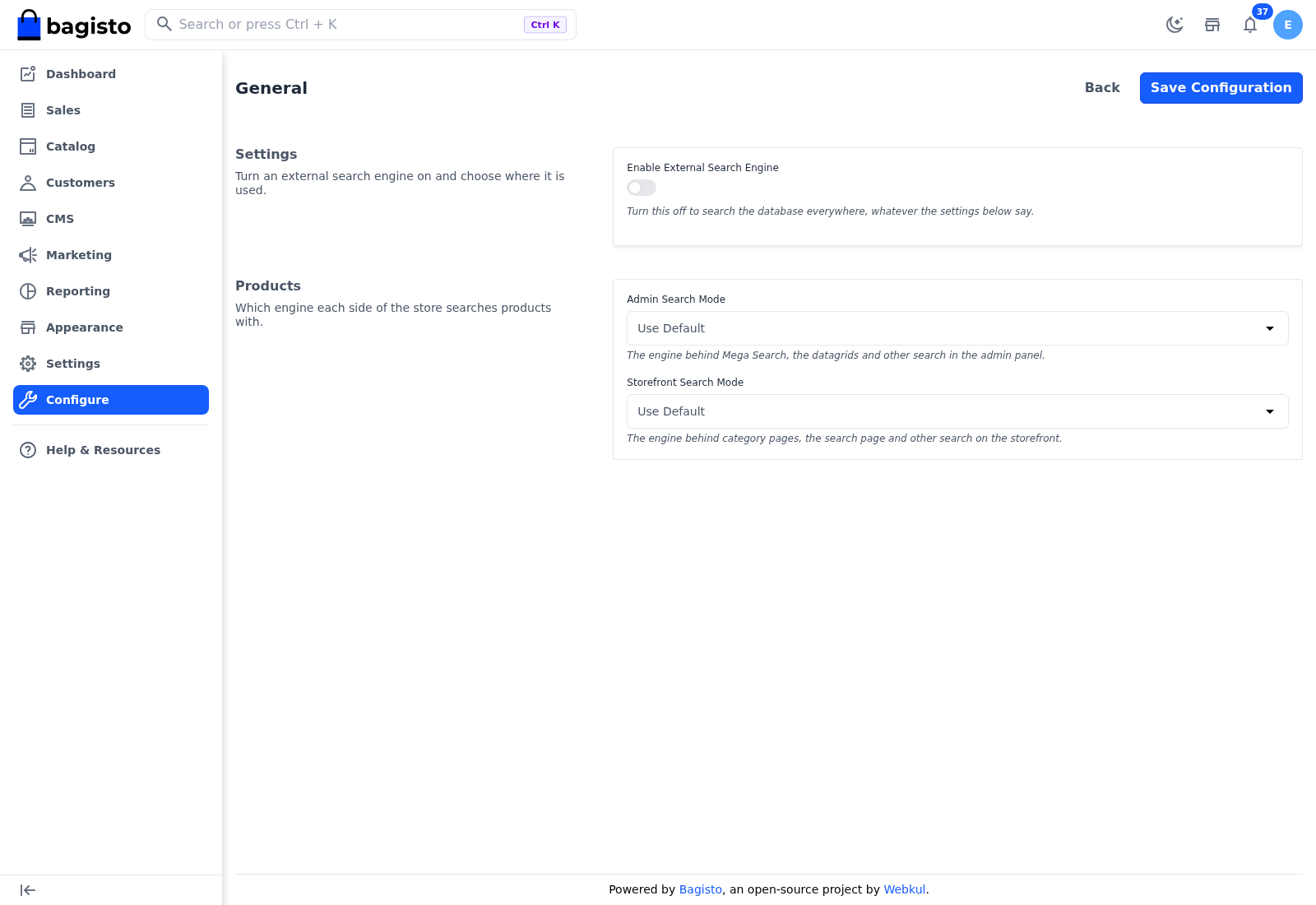
Settings
Enable External Search Engine: Turn this on to use the engine chosen below. While it is off, every search runs on the database whatever the other settings say.
Default Search Engine: Database or Elasticsearch. This is the engine used wherever a search mode below is left on Use Default.
Products
Admin Search Mode: The engine behind the header search, the listing grids and the other searches in the admin panel.
Storefront Search Mode: The engine behind category pages, the search page and the other searches on the storefront.
Each can be Use Default, Database or Elasticsearch, so you can, for example, keep the admin on the database while the storefront searches Elasticsearch.
Click Save Configuration.
Elasticsearch
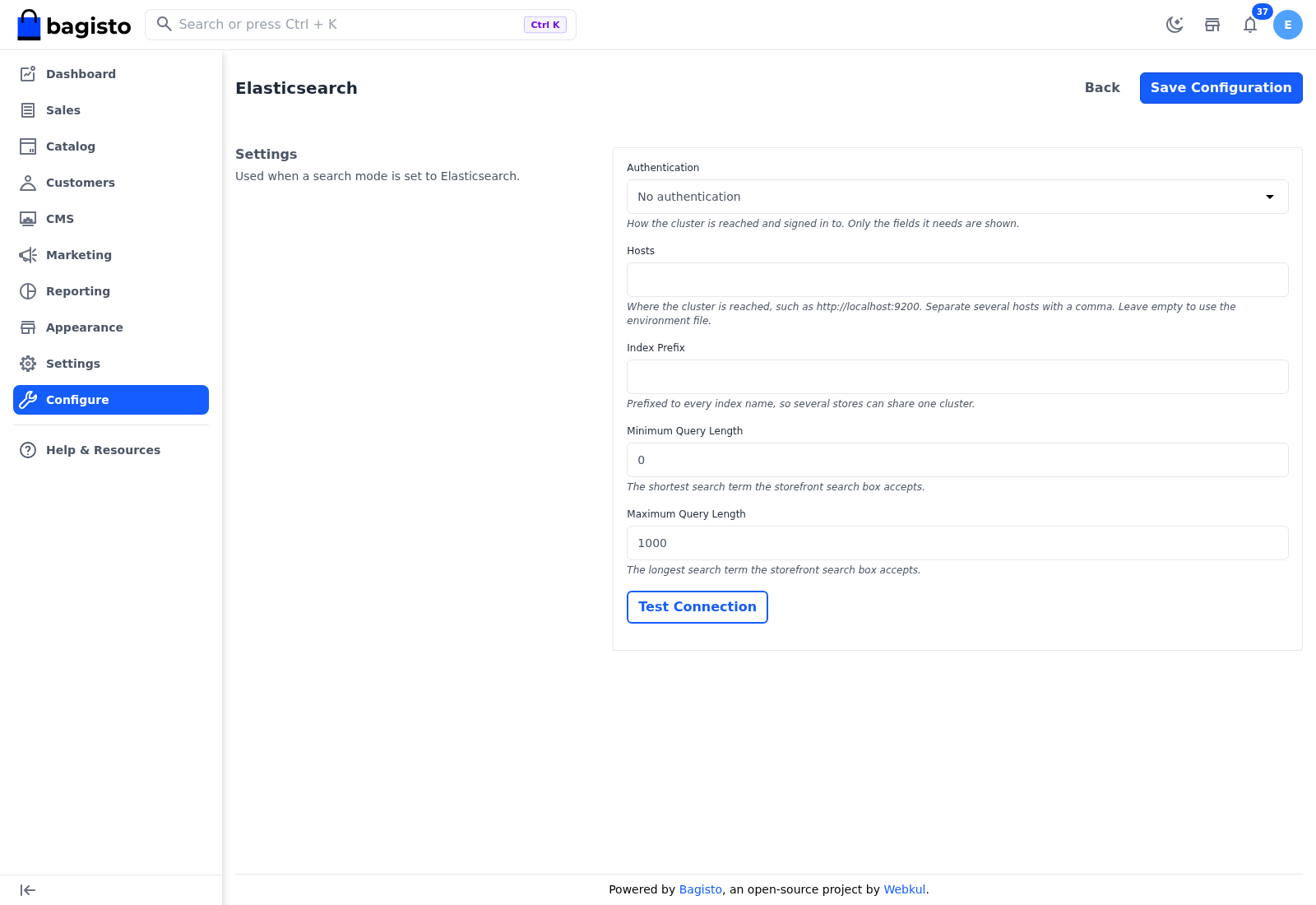
These settings are used only when a search mode is set to Elasticsearch.
Authentication: How the cluster is reached and signed in to. Only the fields the chosen method needs are shown:
- No authentication — just the Hosts.
- Username and password — Hosts, Username and Password.
- API key — Hosts and API Key.
- Elastic Cloud with API key — Cloud ID and API Key.
- Elastic Cloud with username and password — Cloud ID, Username and Password.
Hosts: Where the cluster is reached, such as http://localhost:9200. Separate several hosts with a comma. Leave it empty to use the value from the server's environment file.
Index Prefix: Added to the front of every index name, so several stores can share one cluster.
Minimum Query Length and Maximum Query Length: The shortest and longest search term the storefront search box accepts.
Testing the connection
The Connection row has a Test Connection button. Click it after saving to check the cluster from the server's side. The result tells you whether the engine is available, did not answer, rejected the credentials, answered but is not a supported Elasticsearch server, or is not configured.
Building the index
A cluster only returns products that have been indexed. After connecting it for the first time, ask whoever manages the server to run the product indexer for the search engine; it also runs on the queue whenever a product is saved, so the index keeps itself current afterwards.